
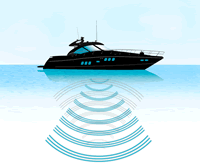
 Adding a transducer to your compatible Garmin fishfinder or chartplotter - such as the Garmin ECHOMAP UHD2 75cv - gives you a live view of what lies beneath your boat. ActiveGPS stocks the very latest Garmin transducers, including the Panoptix All-Seeing Sonar range. The newest transducers go far beyond a simple downward view, offering SideVü, ClearVü and RealVü 3D Forward sonar to show you what's below, to the sides and in front of your vessel in real time.
If you already know which transducer you need, complete the online form below and we'll email you with a link to the compatible transducer(s) available from ActiveGPS for your specific Garmin fishfinder or chartplotter.
If you'd like to learn more before making a decision, scroll down to our full buying guide - covering mounting types, deadrise angles, sonar technology and chart compatibility - then come back to the form when you're ready.
Jump to a section:
‣ Garmin Transducer Buyer's Guide
‣ Transducer Mounting Options
‣ Deadrise Angle
‣ Different Types of Sonar
‣ Garmin BlueChart Marine Charts
Garmin Transducer Selection Form
Complete the form below and we'll email you with a link to the compatible transducer(s) available from ActiveGPS that suit your requirements and work with your Garmin chartplotter or Garmin fishfinder.
By clicking 'Send request' to submit your boat details and personal data you agree to our Privacy Policy.
Garmin Transducer Buyer's Guide
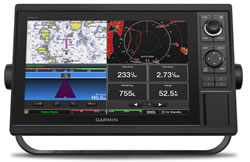 Garmin transducers are compatible with selected Garmin fishfinder models and all Garmin chartplotters that include a sounder, such as the Garmin GPSMAP 1222. A transducer works by sending sonar signals into the water and receiving the returning echoes, allowing your Garmin device to display depth readings, fish targets and underwater structure.
If you're new to buying a transducer, the video below (produced by Garmin) is a great starting point. Further down this page we cover the different ways to mount a transducer on your boat, explain the different types of sonar available, and look at the Garmin BlueChart marine charts you can add to your device.
Quick Garmin Transducer Selector
If you're unsure which Garmin transducer you need, the quick guide below can help you choose the most suitable mounting type for your boat.
| Boat Type | Recommended Mount | Typical Example |
|---|---|---|
| Small fishing boats or trailer boats | Transom Mount | GT23M-TM or Airmar P66 |
| Fibreglass hull boats where drilling is not preferred | In-Hull Mount | Airmar P79 |
| Larger boats requiring maximum sonar performance | Thru-Hull Mount | Airmar P319 or Airmar B60 |
Transducer Mounting Options
There are three main ways to mount a transducer on your boat:
1. In-Hull Mount
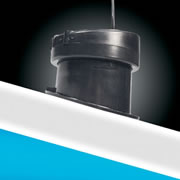 In-hull transducers are installed inside the hull, transmitting their sonar signal directly through the hull material without requiring a hole to be drilled.
In-Hull Mount Pros
‣ No need to drill through the hull - no drag
‣ Boat can be trailered without risk of damaging the transducer
‣ No exposure to marine growth
‣ Can be installed and serviced while the boat is in the water
‣ Excellent high-speed performance where water flow below the hull is clean (no turbulence)
‣ Compatible with inboard, outboard and I/O engines when installed over solid fibreglass
‣ Suitable for both power and sailboats
In-Hull Mount Cons
‣ Not recommended for metal, wood or cored fibreglass hulls
‣ Some signal loss occurs from transmitting through the hull
Examples of Garmin in-hull transducers include the Airmar P79, GT8HW-IN and GT15M-IH.
2. Transom Mount
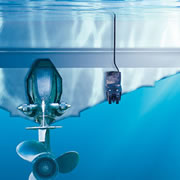 Transom mount transducers attach to the outside of the boat's transom (the flat surface at the stern), sitting just below the waterline. They are the most common and easiest transducer type to install.
Transom Mount Pros
‣ Ideal for trailered boats - out of the way of rollers
‣ Easy to install and remove, especially with a kick-up bracket
‣ Good performance at speeds below 30 knots (34 mph)
‣ Compatible with any hull material
Transom Mount Cons
‣ Not suitable for boats with an inboard engine due to turbulence forward of the sensor
‣ Not recommended for sailboats due to excessive heeling
‣ Will not work on stepped hulls
Examples of Garmin transom mount transducers include the Airmar P66, Plastic Transom Mount, GT20-TM and GT23M-TM.
3. Thru-Hull Mount
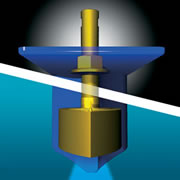 Thru-hull transducers are installed through a hole drilled in the hull, allowing the transducer to sit flush with or protrude slightly below the hull surface for the best possible sonar performance.
Thru-hull transducers come in two styles:
1. Flush mounts sit flush or nearly flush with the hull and are recommended for smaller boats with a minimal deadrise angle.
2. External mounts extend beyond the hull surface and typically require a fairing block to aim the sonar beam vertically. These are suited to larger, un-trailered boats.
Thru-Hull Pros
‣ Compatible with inboard, outboard and I/O engines
‣ Suitable for both power and sailboats
‣ Available for every hull material
Thru-Hull Cons
‣ Do not use plastic thru-hull housings in wooden boats - wood swells as it absorbs water and may crack the housing
‣ Do not use bronze thru-hull housings in aluminium or stainless steel boats - the interaction between metals in salt water can cause corrosion
Examples of Garmin thru-hull transducers include the GT23M-TH, Airmar P319 and Airmar B60.
Understanding Boat Hull Deadrise
IMPORTANT: To help ensure you buy the correct transducer, you will also need to know your boat's deadrise angle.
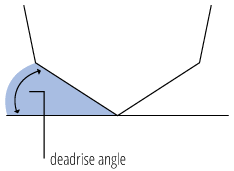
The deadrise angle is the angle between the bottom of the boat hull and the horizontal waterline. Boats with deeper V-shaped hulls have a higher deadrise angle. Many thru-hull transducers are designed for specific deadrise ranges so the sonar beam points directly down into the water.
- 0° - 7° : Flat hull boats
- 8° - 15° : Moderate V hull
- 16° - 24° : Deep V hull boats
Different Types of Sonar
Below we explain the main sonar technologies used by Garmin transducers, fishfinders and chartplotters.
Garmin Sonar Technology Comparison
| Sonar Type | Best For | Description |
|---|---|---|
| Traditional Sonar | Basic depth and fish detection | Uses fixed frequencies such as 50/200 kHz or 77/200 kHz to display fish arches and bottom contours. |
| CHIRP Sonar | Improved fish separation | Transmits a sweep of frequencies rather than a single frequency, providing clearer targets and improved detail. |
| ClearVü | Structure directly below the boat | High-frequency sonar that produces near-photographic images of underwater structures and fish. |
| SideVü | Scanning wide areas | Shows detailed sonar images to both sides of the boat to locate fish and underwater structure. |
| Panoptix / Live Sonar | Real-time fish movement | Shows live sonar images allowing anglers to watch fish swimming and reacting to lures. |
Garmin Transducer Compatibility
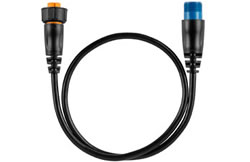 When choosing a Garmin transducer it is important to ensure compatibility with your Garmin fishfinder or chartplotter. Different models support different sonar technologies and connector types. If your transducer connector does not match your device, you may need a Garmin transducer adaptor cable to connect the two.
- Connector type (4-pin, 8-pin or 12-pin) - adaptor cables are available if your connectors differ
- Supported sonar technologies such as CHIRP, ClearVü or SideVü
- Compatibility with your specific Garmin chartplotter or fishfinder model
View the full range of Garmin transducer adaptor cables available from ActiveGPS.
If you're unsure which transducer is compatible with your device, please contact ActiveGPS and we will be happy to help.
 Why Buy from ActiveGPS?
We are official authorised Garmin Internet Retailers, offering genuine Garmin products, accessories, and maps. All our stock is purchased directly from assigned Garmin UK distributors - we do not source from the grey market and never sell counterfeit products.
When you buy from ActiveGPS.co.uk, you can be confident that you’ll receive full Garmin support and the peace of mind that comes with purchasing authentic, reliable products.
This page was last updated on: 21st September 2026